
For decades, the hard part was building it.
When development took months, organizations had to make their bets early. Choose the use case, approve the budget, build the solution, and hope the assumptions held.
AI has changed that equation. But many technology roadmaps still operate as though building is the constraint.
The opportunity isn’t just to build faster. It’s to explore more before committing.
When working prototypes can be delivered in days instead of months, businesses can evaluate multiple approaches to the same problem, test assumptions with actual users, and understand the value before making significant investments.
But there’s a bigger opportunity.
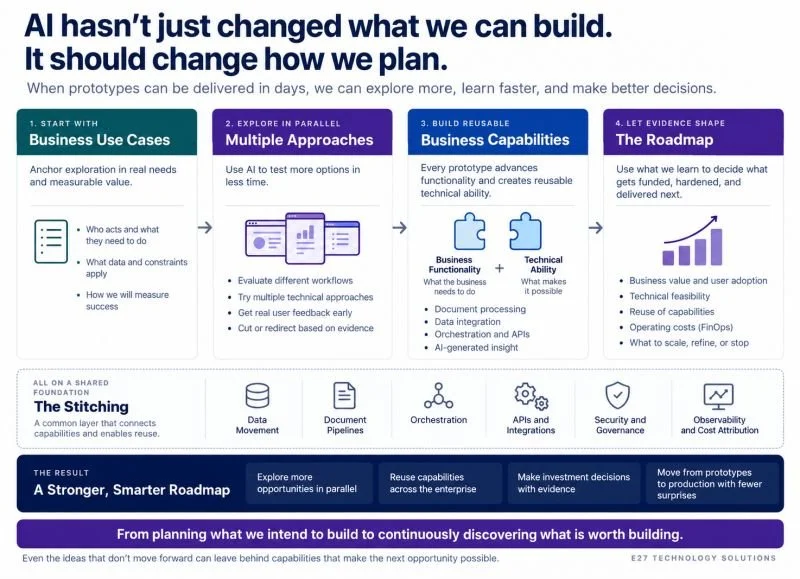
1. Start With Business Outcomes
Anchor exploration in real use cases, measurable value, and the decisions people need to make. Technology should help validate those opportunities, not dictate them.
2. Build Capabilities, Not Just Applications
Every prototype should advance two things: the functionality the business needs and the technical abilities that make it possible.
Those abilities, whether document processing, data integration, or AI-generated insights, should be reusable across other business needs.
3. Explore in Parallel, Build on Shared Foundations
Multiple teams can explore different opportunities while leveraging the same underlying architecture, data, security, and operational controls.
At E27 Technology Solutions, we call the connective layer The Stitching. It allows independently developed capabilities to work together rather than becoming another collection of isolated applications.
4. Let Evidence Shape the Roadmap
Use what prototypes reveal about business value, technical feasibility, reuse, and operating costs to determine what gets funded, hardened, and delivered next.
The roadmap becomes something that evolves with evidence, rather than a sequence of commitments made before the organization has learned enough.
The real shift is from planning what we intend to build to continuously discovering what is worth building.
And when exploration happens on shared foundations, even the ideas that don’t move forward can leave behind capabilities that strengthen the next opportunity.
That’s how AI acceleration becomes a business advantage, not just a development productivity gain.
Read the Full Series
AI Has Changed What We Can Build. It Should Change How We Plan. (this article)
AI Is Changing More Than How We Build. It’s Changing How We Invest.
Originally posted on LinkedIn on October 21, 2026. Join the conversation on LinkedIn.
Watch the walkthrough: Get There Sooner: Production Ready Prototyping, a 6-minute video in our Innovation Tutorials series.
Want to explore how this could work in your organization? Start a Conversation.