
Every roadmap meeting has the same shape.
Someone says they feel strongly about one initiative, someone else champions another, and whoever makes the strongest case usually wins.
It’s not necessarily politics. It’s that the discussion often lacks a common basis for comparison.
And AI is making that problem more important.
When you can build more in less time, deciding what to focus on next much less of a lift.
AI accelerates development, helps teams explore more business use cases, and makes it possible to validate ideas that previously required months of investment.
But faster delivery doesn’t automatically lead to better investment decisions.
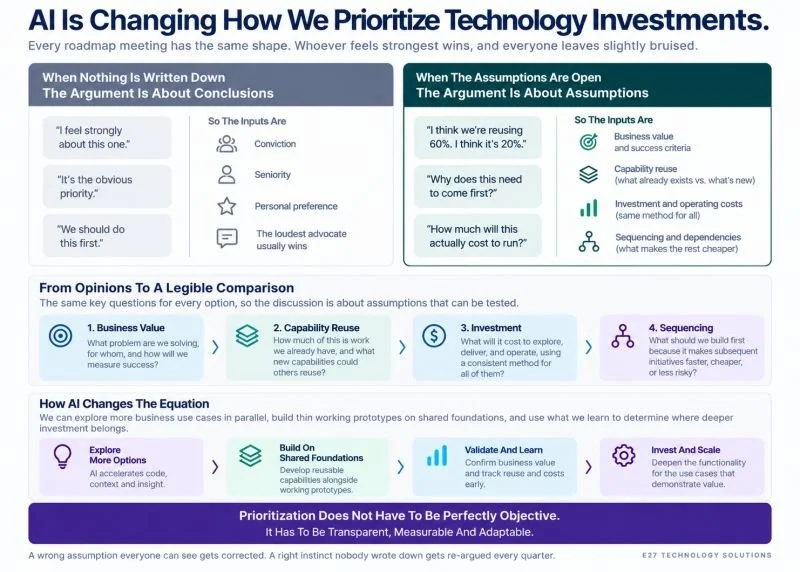
What Changes the Conversation Is Making the Assumptions Visible
Instead of debating which initiative deserves priority, start with a few questions:
Business Value: What problem are we solving, for whom, and how will we measure success?
Capability Reuse: How much of what we need already exists, and what new capabilities could other initiatives reuse?
Investment: What will it cost to explore, deliver, and operate, using a consistent method across initiatives?
Sequencing: What should we build first because it makes subsequent initiatives faster, cheaper, or less risky?
Now the disagreement shifts from opinions to assumptions that can be tested.
“I think we’re reusing 60% of the existing capabilities” becomes something we can validate.
“I feel strongly about this initiative” becomes a starting point, not the deciding factor.
And AI creates another opportunity.
We no longer have to commit to one large initiative before learning whether it delivers value.
We can explore multiple business use cases in parallel, build thin working prototypes on shared foundations, and use what we learn to determine where deeper investment belongs.
That changes prioritization from a one-time competition for funding into a process that continuously improves with evidence.
The estimates won’t always be right. Reuse assumptions will change. Business priorities will evolve.
But when those assumptions are visible, they can be challenged, measured, and refined as each phase delivers new information.
At E27 Technology Solutions, we believe the goal isn’t to eliminate judgment from prioritization. It’s to give business and technology leaders a shared understanding of value, capabilities, costs, and dependencies so they can make better decisions together.
Prioritization doesn’t have to be perfectly objective. It has to be transparent, measurable, and adaptable.
Because in the age of AI, the advantage isn’t simply having the ability to build more.
It’s knowing what deserves to be built next, and why.
Read the Full Series
AI Has Changed What We Can Build. It Should Change How We Plan.
AI Is Changing How We Prioritize Technology Investments (this article)
AI Is Changing More Than How We Build. It’s Changing How We Invest.
Originally posted on LinkedIn on October 26, 2026. Join the conversation on LinkedIn.
Watch the walkthrough: Get There Sooner: Production Ready Prototyping, a 6-minute video in our Innovation Tutorials series.
Want to explore how this could work in your organization? Start a Conversation.