
We’re already using generative AI to summarize documents, work through spreadsheets and move faster every day. The problem is where that work happens: mostly off to the side, where controls drift, definitions stop lining up, ownership gets fuzzy and good ideas never make it past the experiment stage.
At the same time, data is scattered everywhere. So the real question isn’t whether to adopt AI. It’s how to embrace the way people already use it, while turning that activity into operational intelligence the business can actually use.
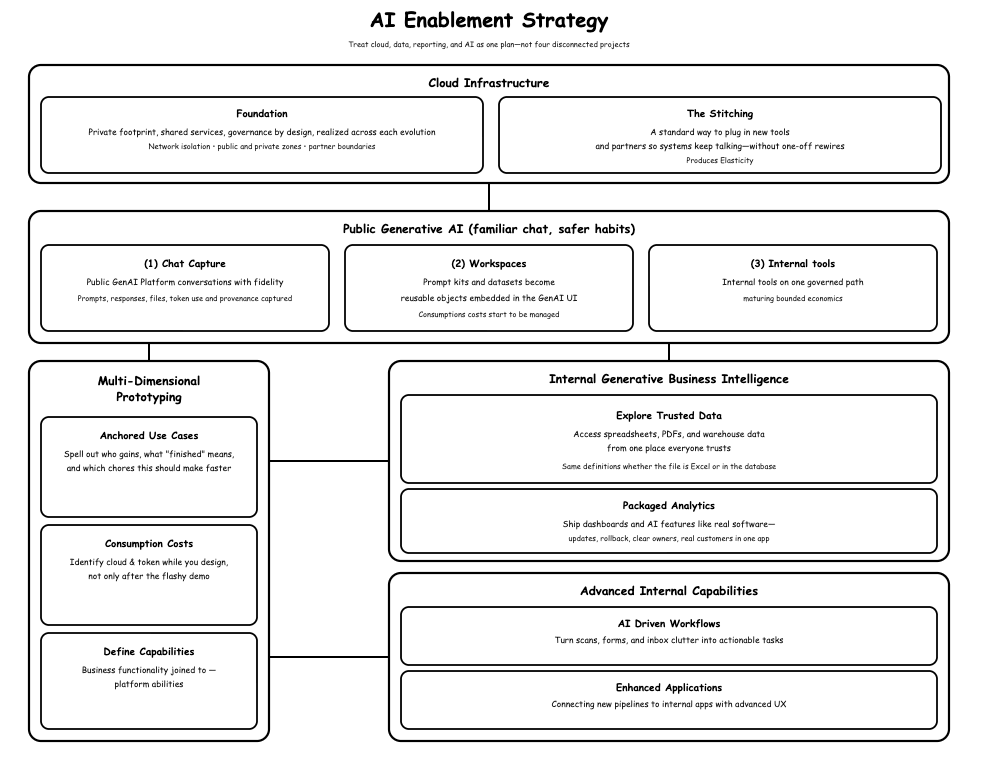
Treat Cloud, Data, Analytics and AI as One Approach
That shift only works when cloud, data, analytics and AI are treated as one connected approach rather than separate programs.
It starts with a secure cloud foundation that establishes clear access, visible data flows, shared services and governance from day one.
On top of that sits the stitching: a connective layer between the cloud, internal systems and third-party tools. It creates repeatable patterns, so we can scale up, scale down, build or buy without reworking everything each time.
Meet People Where They Already Work
We don’t always need to replace the chat tools people already use. We need to put structure around them, so the work becomes visible, governed and reusable. That usually happens in three steps:
Capture the chats, prompts, replies and files into managed storage.
Move into workspaces, where activity becomes structured and reusable across teams.
Connect into governed APIs, warehouses and systems of record.
The goal is simple: meet people where they are and move that behavior onto trusted rails. From there, generative AI can come inside the enterprise in two ways: customized AI experiences that help us explore, and product-grade analytics with embedded AI that help us execute. Both run on the same governed foundation.
Prototypes Need a Real Path to Production
As generative AI activity broadens, prototyping becomes how we move things forward. The workflows and prompt activity captured along the way become operational insight in their own right, improving governance, data readiness and future AI solutions.
That changes what a prototype has to do. We’re no longer just proving something is possible; we need a real path to production. AI helps by generating code, context and insight, so prototypes become more complete, not just faster. A good prototype validates business value, architecture, governance, ownership and cost at the same time.
Prototypes should also span multiple use cases. That’s how we find reusable capabilities instead of isolated solutions, and how experiments become something we can reuse and scale.
Patterns Become Capabilities
Once real capabilities start to emerge, repeatable patterns follow. Document and pipeline intelligence turns documents, data and workflow outputs into structured information and grounded natural-language interaction.
Over time, the same patterns drive intelligence, automation and multi-step workflows. Not uncontrolled autonomous agents, but practical, well-managed assistants embedded directly in how we operate.
One Connected Way of Operating
We’re not trying to launch a separate AI program. We’re building one connected way of operating, where cloud, data, governance, analytics and AI work together, and every prompt, file and interaction adds to something instead of getting lost.
In the near term, that relieves pressure: less shadow IT, clearer ownership, stronger compliance and faster decisions. Over time, every prototype, integration and reporting improvement strengthens the foundation.
That’s how innovation becomes repeatable, trust develops naturally and AI becomes something that actually sticks. Not by chasing autonomy, but by building on patterns we can reuse.
Watch the walkthrough: AI Enablement Roadmap, a 5-minute video in our Innovation Tutorials series.
Want to explore how this could work in your organization? Start a Conversation.