
Adoption isn’t the challenge anymore; we’re already using AI. The challenge is fragmentation: isolated experiments, disconnected tools and no clear path from innovation to enterprise impact.
We also don’t have the luxury of waiting for a perfect data strategy or a fully built AI engineering team, because the pace of change keeps accelerating. So the real question is how to relieve the pressure before it breaks the system, without disrupting the long-term strategy. How do we move from scattered AI activity to something structured, repeatable and scalable, and use that same activity to strengthen the strategy over time?
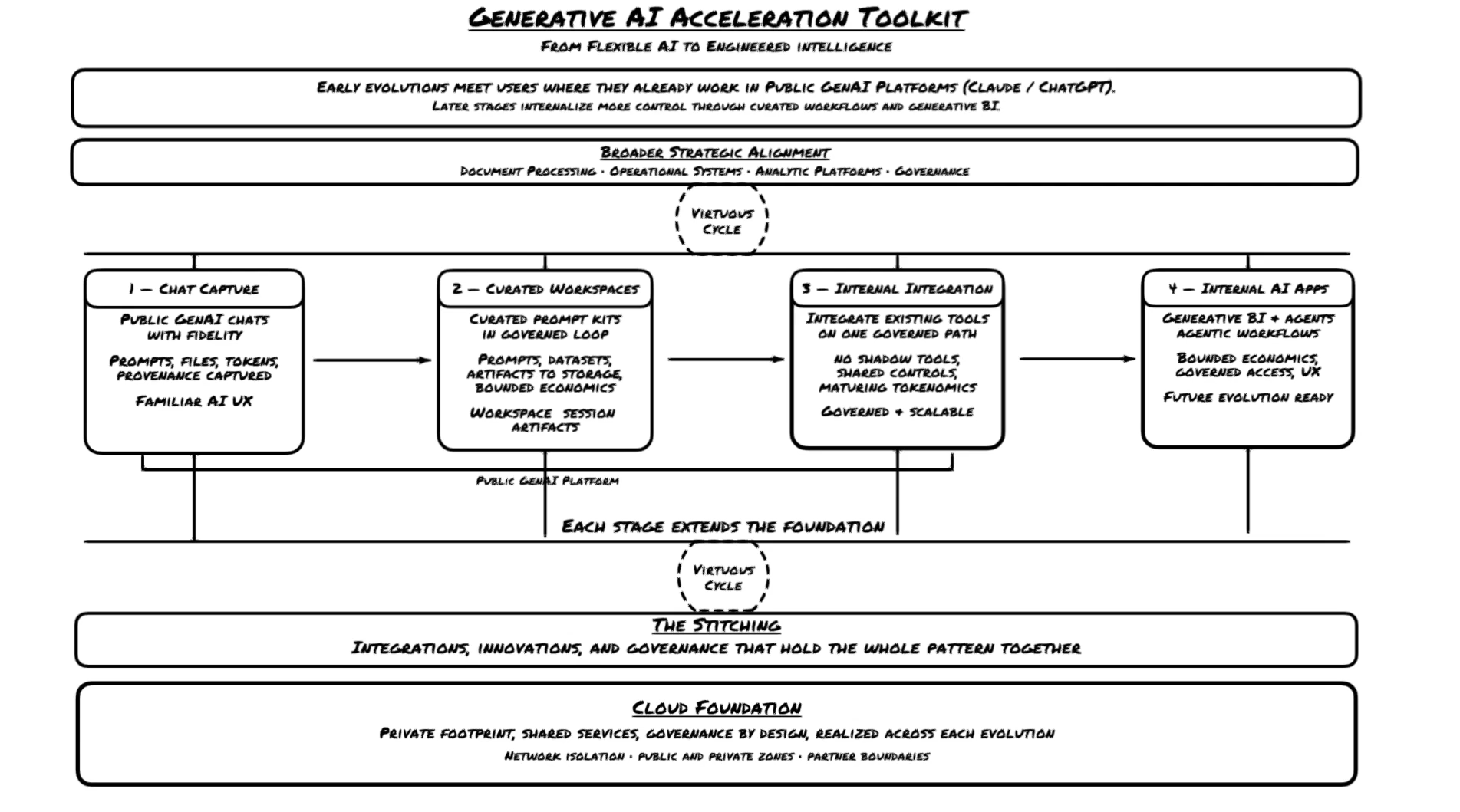
AI Adoption Is an Evolution, Not a Single Implementation
AI adoption starts with exploration, then moves into structured workflows, integrated data and, ultimately, operational intelligence. The fastest way to accelerate that journey is to meet users where they already are: embrace how they use familiar GenAI platforms, and guide that use with governance that strengthens the organization instead of slowing it down.
With a secure cloud foundation in place, AI initiatives can begin as independent exploration, giving teams the flexibility to move quickly and capture value. But AI can’t evolve in isolation. It has to be coordinated and aligned with the broader business strategy over time.
That’s where the stitching comes in: a flexible connective layer across AI, data and systems, built on top of the cloud foundation. It’s what turns independent innovation into cohesive enterprise intelligence.
Stage 1: Capture What People Already Do
Early on, teams work in familiar GenAI platforms such as Anthropic Claude and OpenAI ChatGPT. Instead of isolated conversations, every prompt, response, file and interaction is captured with governance behind the scenes. Not just for control, but to preserve the discovery itself.
That creates a structured, observable history: token usage, context, provenance and a growing record of how teams explore, test and learn. Experimentation stops disappearing and starts compounding. Patterns can be reused, successful approaches repeated, and exploration becomes a sustained capability rather than a series of disconnected moments.
Stage 2: Curated Workspaces
As AI use evolves, conversations become curated, collaborative workspaces instead of isolated chats. Shared prompts, datasets and outputs create repeatable workflows that teams can reuse and build on together.
The stitching lets context flow from storage into AI and back again. This is also where the economics become more bounded: curated workspaces improve consistency, reuse and token efficiency over time.
Stage 3: Internal Integration
As usage grows, so does the demand for consistent data and governed system integration. The next step connects AI to enterprise tools through a single governed surface, improving coordination, consistency and token efficiency.
We move from curated workspaces to governed enterprise execution, and we learn from real data, governance and user behavior along the way. That accelerates the strategy through practical experience instead of waiting for perfect conditions.
Stage 4: Internal AI Applications
That maturity opens the way to internal applications with embedded AI, governed data and purpose-built experiences. Supported by the stitching and the secure cloud foundation, AI becomes scalable, reusable and the foundation for future innovation.
The Virtuous Cycle
As AI evolves across the organization, a virtuous cycle emerges. Strategic alignment and governance give us visibility, turning experimentation into learning instead of isolated activity. Those lessons improve data, strengthen systems and create reusable capabilities that compound over time. And the stitching lets those insights flow across the organization, so every step builds on the last.
Watch the walkthrough: Releasing the Pressure: AI Acceleration Toolkit, a 6-minute video in our Innovation Tutorials series.
Want to explore how this could work in your organization? Start a Conversation.