
Organizations have always had to choose between building and buying: custom capabilities or third-party platforms. That isn’t new. What’s changed is AI.
AI has dramatically increased the speed of innovation, the number of available solutions and the demand for integration across systems. Build, buy, integrate and innovate are all happening at the same time, and much faster. But they’re not happening in a coordinated way, and over time that creates tension, complexity and fragmentation across the enterprise.
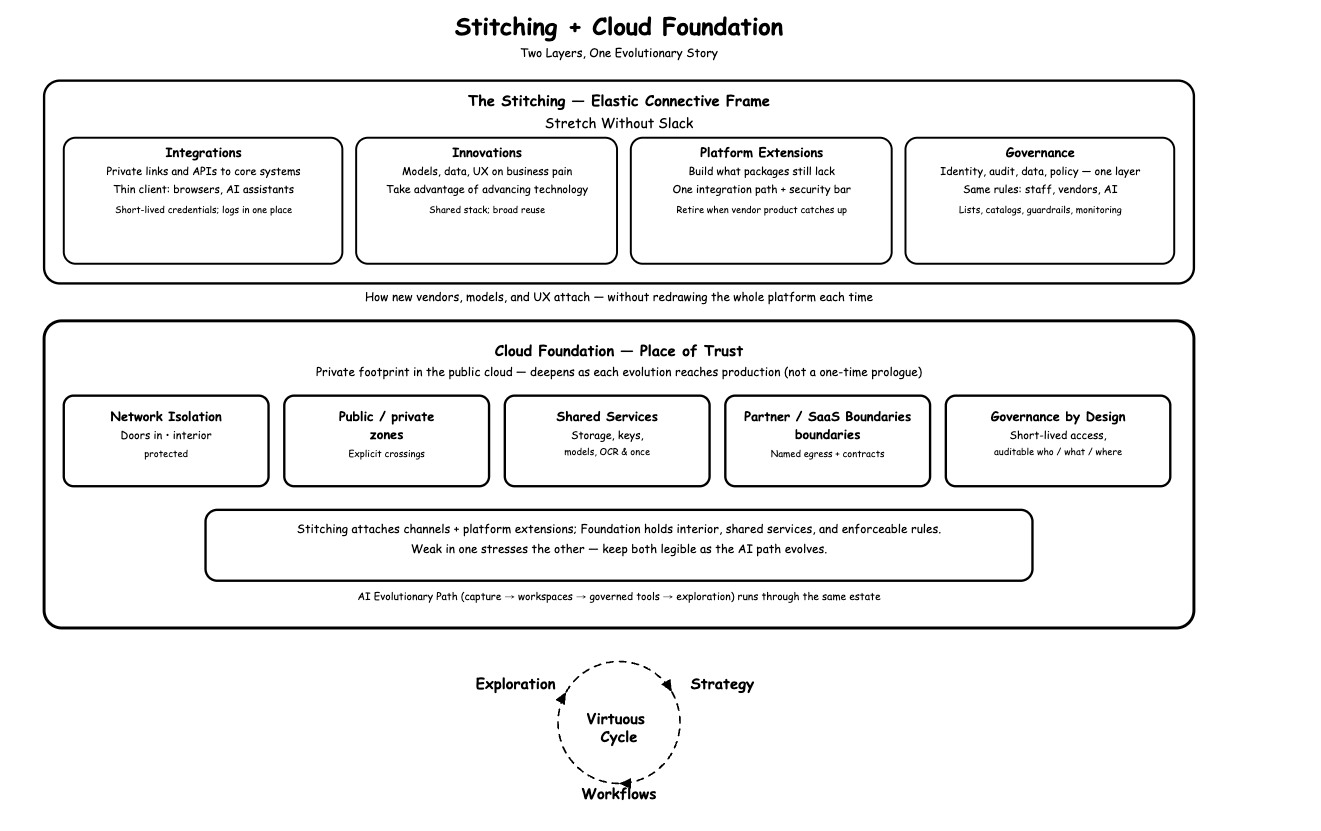
An Evolutionary Path That Stays Elastic
Instead of choosing between speed and control, organizations need an evolutionary path: from early AI usage, to structured capabilities, to fully governed enterprise integration. Each step builds on the last.
But the path isn’t rigid, and it isn’t a fixed architecture. It’s elastic. It expands as new capabilities arrive and contracts as systems become more aligned, absorbing new tools, workflows and demands without breaking or fragmenting. Without that elasticity, every new capability creates tension, and tension leads to complexity.
AI also accelerates the journey itself, letting organizations start faster, evolve more quickly and implement change with far greater precision than before.
The Cloud Foundation: A Place of Trust
Beneath the whole evolution is the cloud foundation: the operational backbone where workloads run, data is governed and access is securely managed. It defines the environment in which AI capabilities scale while staying controlled.
The foundation draws clear boundaries between what’s externally accessible and what stays securely governed. It centralizes shared capabilities such as storage, data and document processing, and access control, so the ecosystem grows within a consistent framework instead of as disconnected solutions.
The Stitching: Connection without Constant Redesign
Structure alone isn’t enough. New tools, systems and integrations arrive constantly, and without a consistent way to connect them, flexibility quickly becomes fragmentation.
The stitching sits between the cloud foundation and the internal and third-party systems that power AI across the enterprise. It links systems through consistent patterns and shared standards, enables integration without constant redesign, and extends governance across the whole ecosystem as technology and business needs evolve. Generative AI’s ability to generate code, context and insight speeds this work up.
Integration Solves for Today; Extension Closes the Gaps
Integration solves for today, not for what’s still missing. Organizations also need to extend capabilities, close critical gaps and innovate on top of existing platforms. Not everything should be built, and not everything should be limited by what was bought.
The goal is strategic flexibility: the ability to build and buy as needed, with capabilities layered in, evolved and reduced over time without disrupting the broader architecture.
None of this works without strong information governance, data quality and management, unified access to data and documents, and a consistent taxonomy that organizes information in business terms. That’s also what makes enterprise systems far easier for large language models to interpret, and what leads to stronger decisions.
Governance Can Start Early and Mature over Time
Governance doesn’t need to be perfected up front. The elasticity of the stitching lets it begin early and mature over time, strengthening control and trust without slowing innovation.
That creates a virtuous cycle. Early exploration drives real learning. Learning shapes strategy: what to standardize, what to scale and what to govern. Strategy improves operations, and operations generate new insight that fuels the next round of exploration. Innovation strengthens governance, and governance accelerates innovation.
Controlled Elasticity
Together, the foundation and the stitching create controlled elasticity. Organizations can evolve continuously as business needs and technology change, without losing alignment, governance or control. That’s what lets AI scale as a coordinated enterprise capability, rather than a collection of disconnected efforts with a limited shelf life.
Watch the walkthrough: Build vs Buy: The Elastic Stitching, a 6-minute video in our Innovation Tutorials series.
Want to explore how this could work in your organization? Start a Conversation.