
The AI Enablement Strategy
The challenge enterprises have is not AI adoption—it is fragmentation created when AI operates outside a unified strategy. With a secure foundation, governed integration, and disciplined prototyping connect data, analytics, and AI we turn disconnected approaches into one operating model. The result is scalable, trusted enterprise capability—not isolated experiments.
Connect with me on LinkedIn to dig into how this can be implemented in your organization.
-
We’re already using generative AI to summarize documents, work through spreadsheets, and move faster every day. The problem is that much of it is happening off to the side, where controls drift, definitions stop lining up, ownership gets fuzzy, and good ideas never make it past the experiment stage.
At the same time, data is scattered everywhere, and we need a way to keep moving fast without everything becoming messy. The question becomes how we embrace how people are already using AI while still turning that activity into operational intelligence the business can actually use.
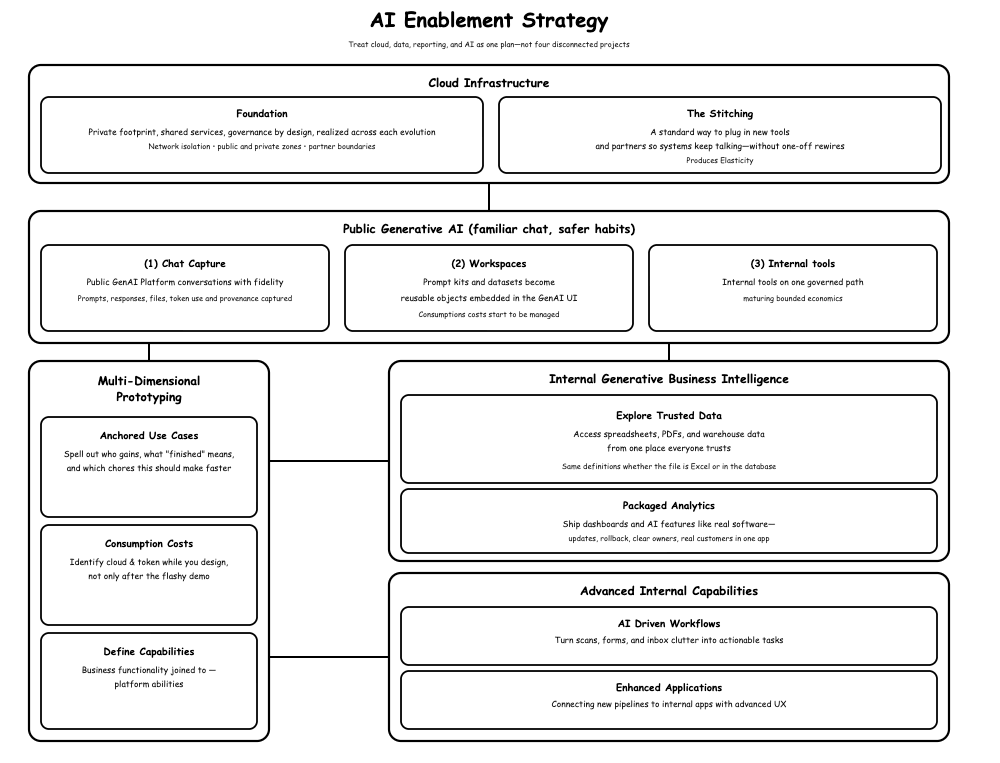
That shift only works when cloud, data, analytics, and AI are treated as one connected approach. It starts with a secure cloud foundation that establishes clear access, visible data flows, shared services, and governance from day one.
On top of that is the stitching layer that connects cloud, internal systems, and third-party tools. It creates repeatable patterns so we can scale up, scale down, build, or buy without constantly reworking everything.
We don’t always need to replace the chat tools people are already using. We just need to put structure around them so the work becomes visible, governed, and reusable.
That usually happens in three steps: first we capture the chats, prompts, replies, and files into managed storage. Then we move into workspaces where activity becomes structured and reusable across teams, before finally connecting into governed APIs, warehouses, and systems of record.
The goal is simple: meet people where they are and move that behavior onto trusted rails. From there, we begin bringing generative AI inside the enterprise through customized AI experiences and product-grade analytics with embedded AI.
One path helps us explore, while the other helps us execute. Both run on the same governed foundation.
As we work across broader generative AI activities, prototyping becomes how we move things forward. The workflows and prompt activity captured from generative applications also become operational insight themselves, helping improve governance, data readiness, and future AI solutions.
That changes what prototyping needs to become. We are no longer just proving something is possible — we need a real path to production.
AI helps accelerate that process by generating code, context, and insight so prototypes become more complete, not just faster. They need to validate business value, architecture, governance, ownership, and cost all at once.
They also need to span multiple use cases so we identify reusable capabilities instead of isolated solutions. That is how we move from experiments to something we can actually reuse and scale.
Once we begin identifying real capabilities, repeatable patterns start to emerge. We see document and pipeline intelligence turning documents, data, and workflow outputs into structured information and grounded natural language interaction.
Over time, those same patterns begin driving intelligence, automation, and multi-step workflows. Not uncontrolled autonomous agents, but practical, well-managed assistants embedded directly into how we operate.
We are not trying to launch a separate AI program. We are building one connected way of operating where cloud, data, governance, analytics, and AI work together.
Everything starts building on itself. Every prompt, file, and interaction adds to something instead of getting lost.
In the near term, that reduces pressure through less shadow IT, clearer ownership, stronger compliance, and faster decisions. Over time, every prototype, integration, and reporting improvement strengthens the foundation.
That is how innovation becomes repeatable, trust develops naturally, and AI becomes something that actually sticks. That is how we make it practical — not by chasing autonomy, but by building on patterns we can reuse.