
We’re all experimenting with AI already. For most organizations that aren’t building their own models, functionality is no longer the bottleneck. We’re no longer asking whether AI can work. We’re asking how to operationalize it and connect it to trusted data and workflows.
That means prototyping has to change. Historically, a prototype proved that a single use case could work. Today, the challenge is proving it can work repeatedly across the enterprise, in a way that’s trusted, sustainable and ready for production. The goal is to make the path from exploration to production faster and cleaner, and to make the next use case easier than the last.
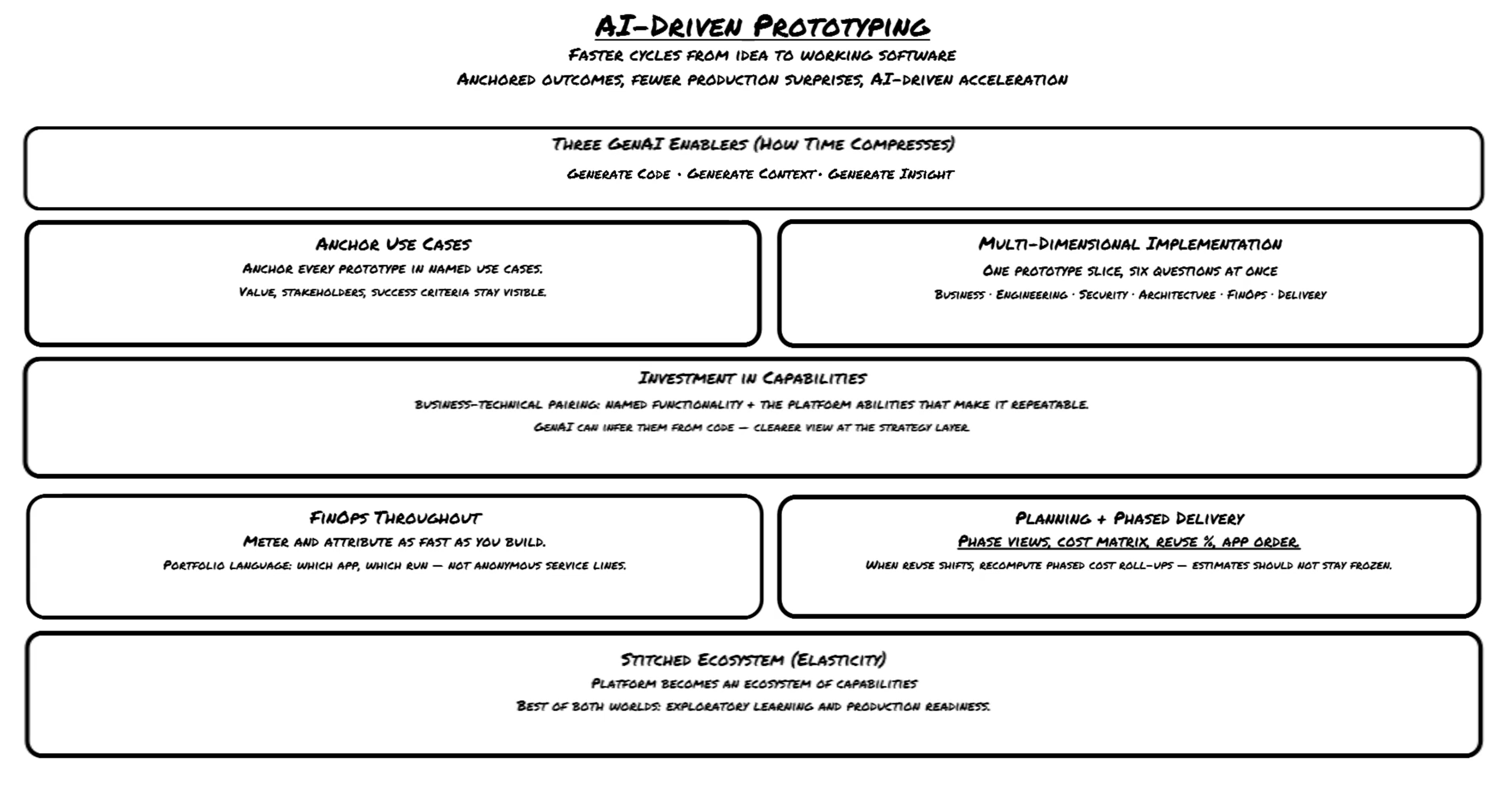
Code, Context and Insight Compress Time
Generative AI changes the economics of prototyping because it helps generate three things dramatically faster than before:
Code: services, workflows, APIs, interfaces and automation, so what once took weeks can be explored in days.
Context: summarizing documents, explaining architecture and aligning business and technical teams faster.
Insight: identifying patterns, comparing options and surfacing stronger paths before major engineering investment is made.
Together, they compress time and widen exploration. The same team can evaluate far more possibilities in the same window, while building toward reusable capabilities instead of isolated experiments.
Speed without Structure Is Fast Chaos
Speed alone creates risk. Rapid prototyping without structure quickly becomes fast chaos. That’s why every prototype needs to be anchored in real use cases, workflows, governance boundaries and measurable business outcomes. We’re not building demos anymore. We’re validating capabilities and real production pathways.
Make Prototyping Multidimensional
Engineering, architecture, security, finance and delivery planning all need to move together from the beginning. A prototype shouldn’t be treated as a disposable experiment; it’s a controlled slice of the future production ecosystem.
Architecture helps us scale it. Security helps us trust it. FinOps helps us sustain it. And delivery planning turns today’s investment into faster progress tomorrow.
Name the Capability
A capability isn’t just technology, and it isn’t just a business objective. It’s the pairing of both: business functionality connected to the technical abilities that make it real.
Take document intake. Intake is the business functionality; OCR, contextualization and governed AI workflows are the technical abilities behind it. Together, they make up the capability. When those pairings are explicit, product, engineering and finance finally start talking about the same thing, and the conversation moves from tools and platforms to the capabilities we’re actually building.
Generative AI helps here too, because it can explain not just the code but the architecture, relationships and business functions behind it.
Know the Cost as Fast as You Build
If AI lets us build faster, we also need to measure, attribute and govern cost just as fast. Cloud and token spend can’t be a monthly surprise. We need visibility by application, workload, document and prototype, so we understand where the money goes and what value it supports.
When capabilities are the focus, every use case strengthens the next. Delivery gets faster, cheaper and easier, and prioritization becomes less political and more effective.
Stitch Capabilities into an Ecosystem
This only works when capabilities are stitched into a shared ecosystem instead of scattered apps and isolated pilots. OCR feeds contextualization, contextualization feeds insight, insight feeds decisions, and every new experience builds on shared architecture instead of starting over.
The value isn’t in building more prototypes. It’s in how capabilities connect and compose. That stitching creates the elasticity to explore broadly while still deepening intentionally, so we can experiment widely without losing coherence. Not faster prototypes in isolation, but broader innovation with reusable capabilities, clear economics and deliberate paths to production.
Watch the walkthrough: Get There Sooner: Production Ready Prototyping, a 6-minute video in our Innovation Tutorials series.
Want to explore how this could work in your organization? Start a Conversation.