
Before we talk about AI, we need to talk about the foundation underneath it.
Most organizations aren’t struggling with access to AI. They’re struggling with what AI exposes: fragmented data, poor quality, disconnected systems and low trust. AI didn’t create these problems; it magnified them at enterprise scale. Faster decisions need better information, better automation needs stronger control, and better outcomes need greater trust.
Piecing vendors together into a bloated “modern data stack” won’t solve this. What solves it is making the puzzle less complex: a simpler approach that brings speed, confidence and enterprise value.
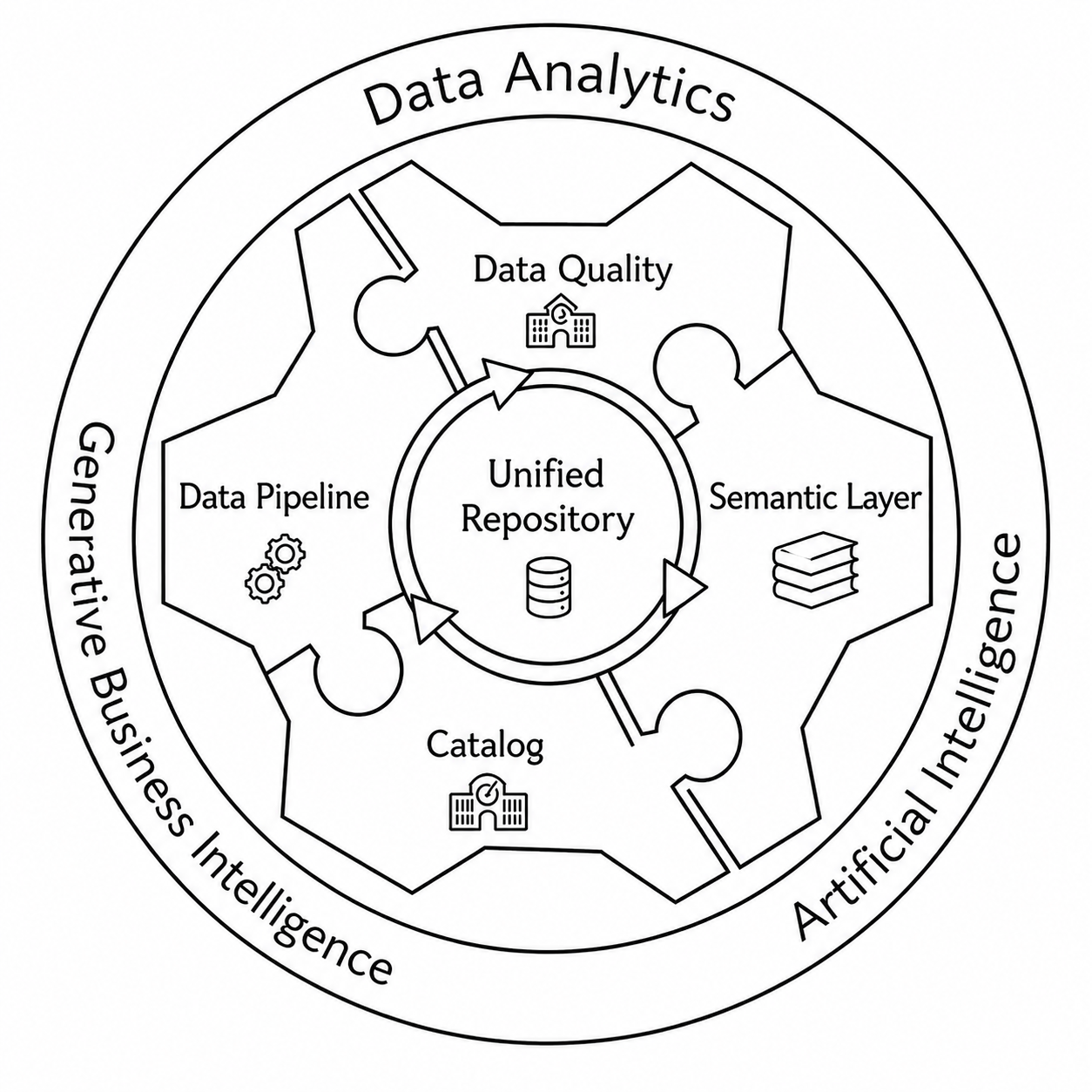
One System, Six Connected Areas
A data enablement strategy creates clarity across six areas: how information moves, where it lives, whether it can be trusted, whether it can be found and understood, how business meaning is standardized, and how leaders interact with insight. These aren’t separate investments. They’re one connected system.
When they work together, they create a virtuous cycle. Better data creates better insight, better insight creates better decisions, and better decisions create stronger performance and the need for even better insight. AI strengthens the cycle by helping prepare data for better AI consumption.
1. How Information Moves
Most organizations think AI starts with the model. It doesn’t. It starts with how information moves. If information is delayed, fragmented or hard to trust, AI simply scales the problem.
What’s needed is coordinated movement across operations, documents, workflows and decisions. Information must move reliably, be visible and be reusable, so every new initiative builds on what already exists. This is also where AI creates immediate value: accelerating workflows, reducing manual effort and shortening time to execution.
2. Where It Lives
Not all information should be centralized, and often it isn’t practical. Some has to stay close to the teams that use it. Some lives in operational systems, documents and local files. Some changes too quickly to force into one platform.
But when access fragments, definitions drift, reports stop aligning and leaders get conflicting answers. Hesitation follows, and hesitation creates cost. The answer is unified access: not necessarily a centralized platform, but one trusted channel to information, where structured and unstructured data are governed consistently, security is clear and duplication is reduced.
AI helps build that foundation by defining shared business objects, generating governance and control patterns, and identifying reusable queries that improve performance and consistency across disparate sources.
3. Whether It Can Be Trusted
Poor quality creates invisible costs: rework, reporting errors, missed opportunities and operational inefficiency. At AI scale, mistakes don’t stay isolated. They multiply through automation.
Quality has to move from cleanup to prevention: stronger controls for completeness, consistency and accuracy, and increasingly, AI itself improving quality upstream. Trust isn’t built in the presentation. It’s built in the process.
4. Whether It Can Be Found and Understood
Even trusted information has no value if people can’t find it or understand it. This is where organizations lose speed: people rebuild reports, duplicate effort and create workarounds.
People need clear answers to simple questions. Who owns this information? Where did it come from? Can it be trusted? A strong catalog provides that visibility through discoverability, lineage, context and accountability, and AI makes discovery faster and governance stronger.
5. What It Means
Different parts of the business define success differently. Revenue, performance, productivity: the same words with different meanings, leading to conflicting reports and strategic misalignment.
A semantic layer provides a shared business language. It standardizes definitions and simplifies the underlying data models, so dashboards, analytics and AI all work from the same understanding. AI helps standardize metrics, translate technical names into business terms and simplify complex joins into clear semantic relationships. That shared language gives large language models the context they need, improving accuracy, consistency and trust.
6. How Leaders Interact with Insight
Analytics used to mean dashboards, reports and waiting. But markets move, risk changes and questions evolve daily. Leaders need flexibility, not another static report.
Generative analytics lets people ask questions in natural language and receive insight grounded in trusted enterprise information, not just charts. Better insight leads to better questions, and better questions improve the information itself.
From Fragmented Analytics to a Connected System
The real value is in how these capabilities work together. Information moves efficiently, lives in a governed environment, keeps improving in quality, is easy to find and understand, means the same thing everywhere and is instantly accessible through natural interaction.
That’s the shift from fragmented analytics to a connected, intelligent system, and from isolated AI use cases to a strategy that compounds value over time. AI isn’t replacing strategy; it’s accelerating it. And organizations can use AI to help get there.
Watch the walkthrough: Strong Foundation: Data Enablement Strategy, a 7-minute video in our Innovation Tutorials series.
Want to explore how this could work in your organization? Start a Conversation.