
Some organizations eventually outgrow a governed public GenAI strategy. The question is no longer how to make public GenAI safer. It becomes: how do we use what we’ve learned from captured prompts, workspaces and governed usage to build something more intentional inside the enterprise, without tearing down the data and service infrastructure that got us here?
Other enterprises have no appetite to include public GenAI in their strategy at all. Either way, the internal experience has to match what people have come to expect from public GenAI, or it won’t deliver value. That’s where Generative Business Intelligence begins, and where the journey continues.
A Question Is a Workflow, Not a Prompt
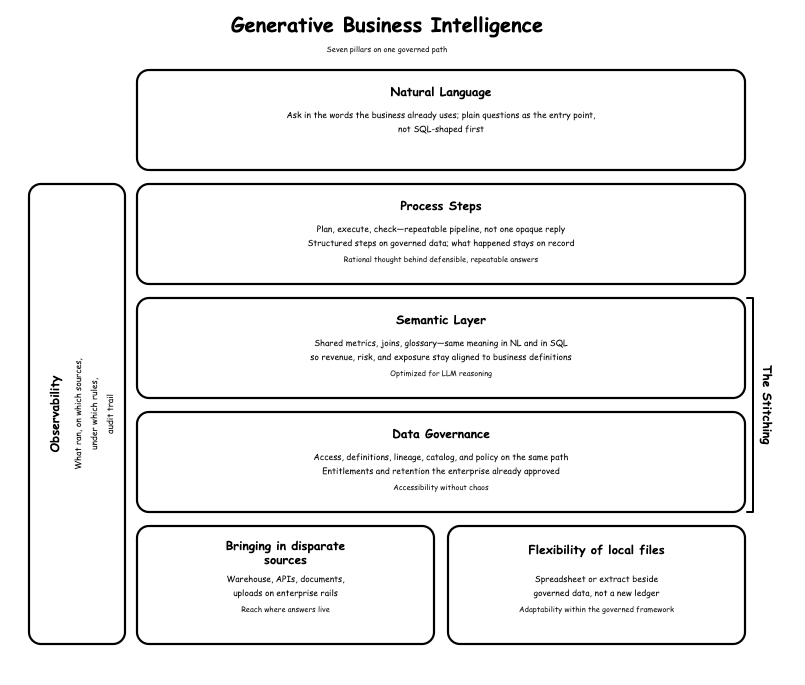
Generative BI shouldn’t treat a business question like a chatbot prompt. It should treat it like a managed analytic workflow. The system plans, runs structured steps against governed data and records what happened.
That includes trusted enterprise sources and the working files teams use every day: the uploaded spreadsheet, the partner extract, the reconciliation file. The result is repeatable, reviewable and tied to evidence, not accepted simply because that’s what the model answered. That’s the difference between generative AI and enterprise decision-making.
Ask in the Words the Business Already Uses
People should be able to ask business questions in the words they already use. What’s driving revenue? Where is risk increasing? Why did exposure move?
The hard part isn’t the question. It’s the answer, because real answers live across governed data, operational systems, documents, uploads and the local files people rely on every day. Those local files are often the fastest path to context, even before they’re part of the broader data strategy.
The business can’t wait for every source to be perfectly integrated, so the goal is one governed path from natural language, across varied sources, to answers people can actually trust.
Generative BI Depends on the Stitching
Whether the stitching was built during the public GenAI journey or is being established now, it becomes the foundation: the governance, the semantics and the trusted path between natural language and enterprise decisions. Generative BI doesn’t replace the stitching. It depends on it.
It uses the same controls, access, policy, lineage and shared business definitions. Who is allowed to see the data? Which sources are approved? Which definitions matter? What lineage needs to be preserved?
Just as important, the same words have to mean the same thing, in terms the business understands. Revenue, risk, exposure and loss can’t be reinvented by the assistant each time someone asks, and they can’t depend on technical table names or column labels. The semantic layer, with its shared metrics, joins, glossary and business definitions, keeps natural language from becoming loose interpretation. It dramatically improves both trust and the model’s reasoning.
Without governance and semantics, natural language feels easy, but the answers become unsafe and inconsistent.
Plan, Execute, Refine
Public GenAI introduced the behavior; Generative BI operationalizes it. It isn’t just a prompt window. It’s a cohesive workflow to reach the answer: not simply ask and respond, but plan, execute and refine.
It works across governed data, documents and local uploads like spreadsheets and reports, so teams can work with what exists today, not just what was formally modeled months ago. Everything still follows the same structured analytic flow. The work stays governed, the logic stays traceable and the answer stays tied to evidence. Narrative follows facts, not the other way around, and local files can sit beside governed data without becoming a new source of truth.
Make It Observable
Finally, the system has to be observable: not just what answer came back, but what ran, which sources were used, which rules applied and what evidence supported the result.
That matters for trust, for cost and for scale. If hundreds of people are going to ask questions this way, the organization needs more than fast responses. It needs a record, so the business can move faster while staying accountable.
The Virtuous Cycle
Generative BI lets three things strengthen each other: clear definitions, reliable data and the ability to ask questions naturally while still getting trusted answers. When people know what the data means, they make better decisions. When data arrives consistently, those decisions move faster. And when better questions are asked, gaps in definitions and quality become visible, so the data, the decisions and the business keep improving over time.
Watch the walkthrough: The Next Chapter: Internal Generative BI, a 5-minute video in our Innovation Tutorials series.
Want to explore how this could work in your organization? Start a Conversation.