
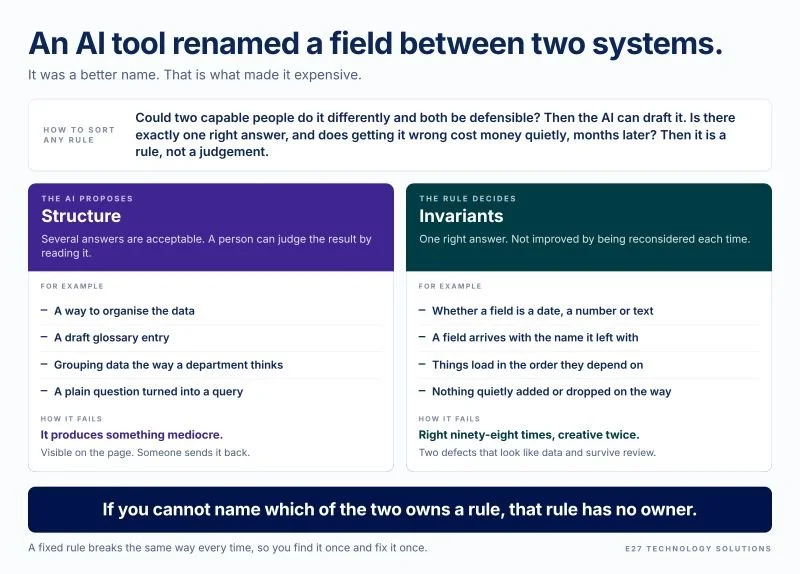
An AI tool renamed a field while copying data between two systems.
It was a better name. That is what made it expensive.
Everything downstream expected the original name. Reports broke. The AI made a reasonable decision in isolation, but violated a contract between systems.
This is where AI engineering gets interesting.
The challenge isn’t simply deciding what AI can and cannot do. It’s creatively combining probabilistic LLMs and deterministic code, allowing each to do what it does best.
LLMs are great at interpreting intent, exploring possibilities, recognizing patterns, and proposing solutions. Deterministic code is great at enforcing contracts, preserving consistency, and producing repeatable outcomes.
The creativity is in how you orchestrate the two.
A few principles guide that thinking:
Separate judgment from execution. Let AI reason through ambiguity, but use deterministic logic where outcomes must be consistent.
Balance rigidity with adaptability. Preserve the predictability of deterministic code without allowing its rigidity to limit AI-driven creativity and innovation.
Constrain without limiting discovery. Establish clear boundaries while giving AI room to explore, challenge assumptions, and propose alternatives.
Turn intelligence into repeatability. Capture useful AI discoveries and progressively convert proven patterns into governed, reusable capabilities.
Design for exceptions. Know when to enforce a rule, when to request human judgment, and when to let AI explore an alternative.
The real risk isn’t that AI gets something wrong frequently. It’s that it gets something wrong occasionally, differently each time, and the error looks perfectly reasonable.
At E27 Technology Solutions, we see this balance as a core principle of AI engineering.
The goal isn’t to maximize how much work an LLM performs. It’s to maximize the value of its intelligence without allowing the rigidity of traditional engineering to limit its potential.
That’s where the real creativity, and the real enterprise value, begins.
Read the Full Series
The One Requirement That Has Never Changed: “I Have a Question About My Data.”
The Art of AI Is Knowing When Not to Use It (this article)
Originally posted on LinkedIn on October 9, 2026. Join the conversation on LinkedIn.
Watch the walkthrough: Strong Foundation: Data Enablement Strategy, a 7-minute video in our Innovation Tutorials series.
Want to explore how this could work in your organization? Start a Conversation.