
An answer isn’t official because it’s correct.
It’s official because it came down a path someone can check.
The same answer can carry a very different level of authority depending on how it was produced, even when the numbers match.
Think of it as a ladder.
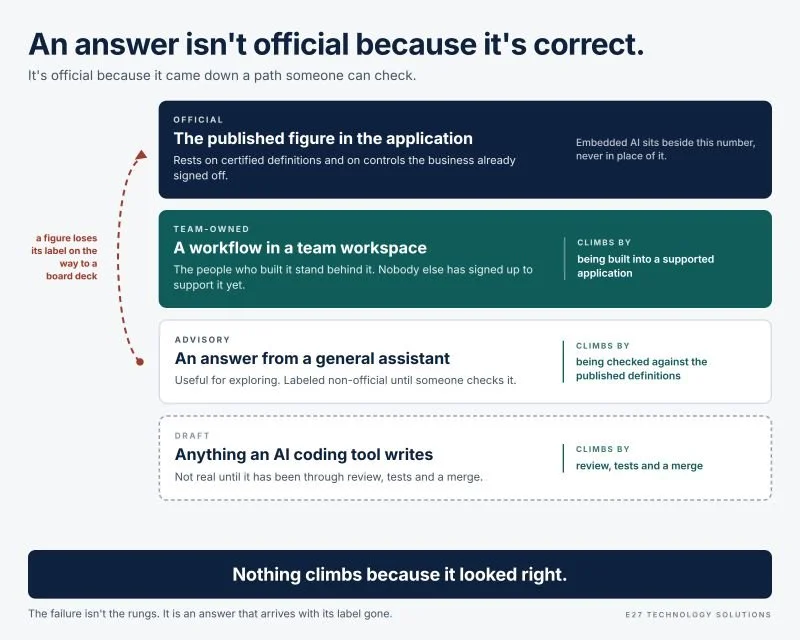
Published
At the top is the figure in the business application. It rests on certified definitions and controls the business has already approved.
Even AI embedded in that same application sits beside the official number. It doesn’t replace it.
Team-Owned
One rung down is a workflow built in a team workspace. The people who built it stand behind it, but the organization hasn’t committed to supporting it yet.
Advisory
Below that is an answer from a general AI assistant. Useful for exploring and analysis, but non-official until it is checked against published definitions.
Draft
At the bottom is anything produced by an AI coding tool. It isn’t real until it has gone through review, testing and a merge.
The important part is that every rung has a defined way up.
A team workflow becomes supported by moving into an application.
An assistant’s answer gains authority by being checked against published definitions.
AI-generated code becomes real through review, tests and CI.
Nothing moves up simply because it looked right.
At E27 Technology Solutions, we think this distinction becomes increasingly important as organizations introduce more AI experiences.
The risk isn’t having different rungs.
It’s having unlabeled answers.
A number leaves a chat window, lands in a board deck, loses its label along the way and gets treated as official without ever being checked.
Label every answer with its rung.
Define what it takes to climb.
Correct is necessary.
Checkable is what makes it official.
Read the Full Series
Your AI Assistant May Have Just Created a Second Route to Your Data
Correct Doesn’t Make an AI Answer Official (this article)
Originally posted on LinkedIn on October 2, 2026. Join the conversation on LinkedIn.
Watch the walkthrough: The Unified Experience: AI Workbench, a 6-minute video in our Innovation Tutorials series.
Want to explore how this could work in your organization? Start a Conversation.